Your Road Trip Outfit Has to Work at the Gas Station, Not Just in the Car

Quick Answer: You spend the drive seated and the stops standing, and those two states have opposite clothing requirements. Outfits chosen for seated comfort — loose waists, long hems, soft slip-ons — usually look and feel worst in the ten minutes you are actually out of the car and around other people. Dress for the stops and the drive takes care of itself.
The outfit felt perfect for the first ninety miles. Then you pulled into a gas station, stood up, caught your reflection in the window, and thought: oh.
Everything had migrated. The waistband had folded over. The hem was creased into a horizontal line across the back of your thighs. And you had another four hours to go.

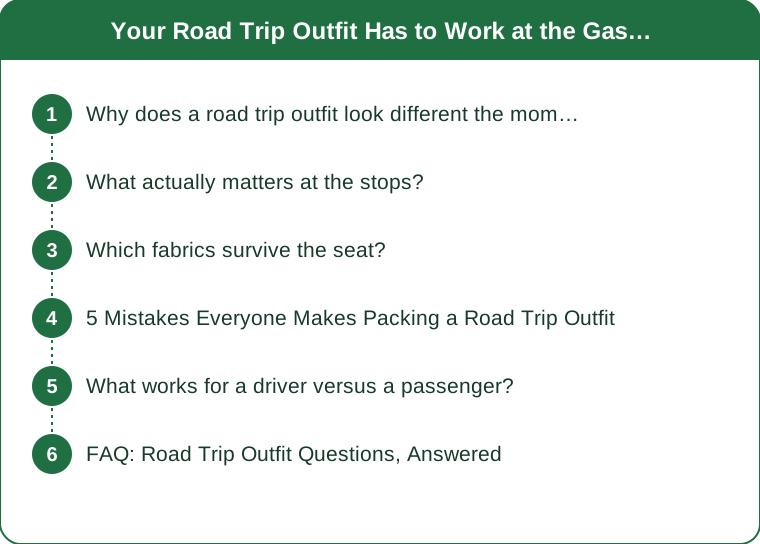
Why does a road trip outfit look different the moment you stand up?
Because seated fabric and standing fabric are two different garments.
Sitting for an hour presses your clothes into a shape and they hold it. Cotton and cotton blends hold it hardest, linen holds it longest, and anything with a high natural-fiber content will carry a crease line across the back of the thigh for the rest of the day. Synthetics recover faster — often within a couple of minutes of walking — which is why travel-specific fabrics have historically leaned synthetic.
The second change is the waist. A waistband that sits comfortably at your natural waist while standing will sit against a compressed stomach while seated, and your body responds by pushing it up or down until it finds room. Over three hours that migration becomes permanent for the day.
So when you stand up, you are not seeing your outfit. You are seeing your outfit after being ironed by a car seat into a shape nobody chose.
What actually matters at the stops?
Four things, and none of them are the ones people plan for.
Getting out of the car gracefully. Narrow skirts and long unstructured hems both make the door-swivel awkward. You want something that lets you pivot both legs out at once without adjusting.
Standing in a cold or overheated store. Gas stations and rest stops are almost never at a comfortable temperature. A layer you can add or drop in under five seconds — a zip-up, a cardigan on the passenger seat, an overshirt — solves this better than a mid-weight everything.
Shoes you can actually walk in. Slip-ons are ideal for driving and mediocre for a 200-yard walk across hot asphalt. If your stops involve any real walking, a sneaker you can loosen while driving beats a slide you can never tighten.
A pocket that survives sitting. Back pockets are unusable in a car and front pockets get crushed. If you want your phone and card accessible, put them somewhere in the car, not on your body.
Which fabrics survive the seat?
Ranked roughly by how they look after two hours in a car seat:
- Ponte, scuba, and technical knits. Almost no crease. Recover in under a minute of walking. The reliable choice.
- Jersey with 5-10% elastane. Very good. Slight compression marks at the waist, gone quickly.
- Heavy woven cotton (denim, twill). Holds shape well, creases at the hip crease only. Fine, but hot in late summer.
- Lightweight cotton and viscose. Creases badly, and the creases are horizontal and unflattering.
- Linen. Beautiful, and it will look like a paper bag by the second stop. Only worth it if you have made peace with that.
A useful test at home: sit on a hard kitchen chair for ten minutes in the outfit, stand up, and look in a mirror. It is a compressed version of the same effect, and it correctly predicts the gas station about 80% of the time.

5 Mistakes Everyone Makes Packing a Road Trip Outfit
1. Dressing for the destination instead of the drive. If you are arriving at dinner, bring the dinner outfit and change in the last rest stop. Wearing it for six hours guarantees it arrives creased.
2. Choosing the loosest thing you own. Loose fabric bunches under a seatbelt and pools around the hips when seated. Semi-fitted actually sits better in a car than fully relaxed.
3. Putting the extra layer in the trunk. If it is not within arm’s reach, it does not exist. The layer you need is the one on the passenger seat.
4. Ignoring the sun on one side. On a long westbound afternoon drive, your left arm and left thigh get real sun exposure through the glass. A short-sleeve outfit that is fine at 10am is a burn line by 5pm. Keep a light long-sleeve within reach.
5. Wearing new shoes. The combination of sitting still for hours and then walking on hot pavement makes feet swell more than either would alone. New shoes that fit in the morning will not fit at the third stop.
What works for a driver versus a passenger?
Drivers need less bulk at the shoulders and a clear ankle. Anything with a wide sleeve interferes with the wheel, and a long hem can get under the pedals. Drivers also generate more heat — you are engaged, not resting — so plan a lighter base layer.
Passengers get to be comfortable, but they also sit more still, which means more compression in one place. If you are the passenger for a long stretch, a softer waistband and a fabric that recovers well matter more than they would for the driver, who is shifting position constantly.
On a trip where you swap, dress for driving. It is the more constrained of the two roles, and a driving outfit works fine in the passenger seat while the reverse is often not true.
FAQ: Road Trip Outfit Questions, Answered
What is the single best all-day road trip piece?
A mid-weight knit set in a technical fabric — matching top and relaxed straight-leg bottom. It reads as an intentional outfit at the stops, the fabric recovers from the seat, and the two pieces let you regulate temperature separately. It is boring advice because it is right.
Should I wear a bra on a long drive?
Whatever you choose, avoid an underwire that sits where the seatbelt crosses. The belt presses the wire into the ribs at a fixed point for hours and that is the specific complaint most people have after a long drive. A soft-cup or a wireless style with the seam away from the belt path is far more comfortable.
How do I stop the seatbelt from wrinkling everything?
You mostly cannot, but you can control where. Run the belt over a structured layer — a denim overshirt, a jacket — rather than directly over a fine knit, and the crease lands on the outer layer you take off at the destination. Also worth adjusting the belt height at the pillar so it does not sit in the same spot for six hours.
TL;DR:
- Your outfit is judged standing at the stops but shaped sitting in the car — dress for the standing.
- Technical knits and jersey with elastane recover from the seat; cotton and linen do not.
- Keep the extra layer on the passenger seat, not the trunk, and keep a long sleeve for afternoon sun through the glass.
- Semi-fitted beats loose in a car seat, and drivers should dress with clear sleeves and clear ankles.
The reframe that makes all of this easy: the drive is not the event. The stops are. You are visible, standing, and walking for maybe forty minutes across an eight-hour day, and those forty minutes are the entire reason the outfit matters. Choose for them, and the seat becomes a detail instead of a problem.
Keep Reading
This article is for general informational and styling purposes only. Fit, sizing, and product availability may vary.