Why the Outfit You Drive In Fails the Moment You Become the Passenger

Quick Answer: Driving holds your body in an active, upright position with weight on your hips and feet. Passenger seating is reclined and static, which shifts pressure to your tailbone, mid-back, and the backs of your thighs. Waistbands and seams that sat in neutral zones while driving land directly on new pressure points, which is why the same outfit turns uncomfortable within twenty minutes of switching.
You drove the first shift and felt fine. Then you swapped at the rest stop, reclined the seat, and forty minutes later your waistband is cutting in and there is a seam somewhere in your lower back you never noticed before. Nothing about your clothes changed.

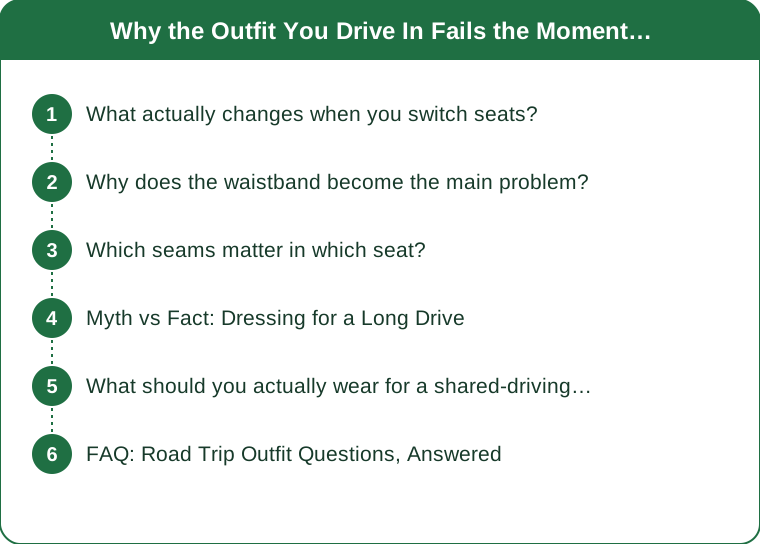
What actually changes when you switch seats?
Your body geometry, and it changes more than it looks like from outside the car.
Driving is an active posture. Your torso stays roughly upright, your hips are flexed at a moderate angle, and your feet carry small continuous loads through the pedals. Weight sits on the back of your pelvis and your feet. Your legs move, slightly but constantly, which keeps circulation going and stops any single pressure point from building up.
Passenger seating is a static posture. You recline, which rolls your pelvis backward and shifts weight onto your tailbone and the soft tissue at the back of your thighs. Your legs stop moving. The contact area between you and the seat gets both larger and more concentrated at the same time — larger because you are lying against more of the seat, more concentrated because nothing shifts to relieve any of it.
That single change re-maps where every seam, waistband, tag, and pocket sits relative to a load-bearing surface. A back pocket that was harmlessly beside your hip while driving is now underneath your weight. A waistband that sat above your hip crease is now pressed into a folded-forward abdomen.
Why does the waistband become the main problem?
Because reclining changes your waist circumference in a way sitting upright does not.
When you recline and your pelvis rolls back, your abdomen compresses forward slightly. Add the natural bloating that comes with a long day of travel — cabin-style dehydration, salty road food, hours without walking — and your waist measurement genuinely increases through the afternoon. Most people gain a measurable amount around the middle over a full travel day, which is not a body problem, it is a fluid and digestion problem.
A rigid waistband is fitted to your morning measurement in your morning posture. By hour five, in a different posture, it is fitted to a body that no longer exists.
The usual instinct is to unbutton or shove the waistband down, which creates a folded band of fabric sitting exactly on the crease where you bend. That is often more uncomfortable than the original problem.
What works instead is a waistband that has nothing to resist against: a wide, flat knit band with no hardware, no button, and no topstitched edge at the top. It does not need to be loose. It needs to be capable of changing size without creating a hard edge.
Which seams matter in which seat?
Different ones, which is the whole point.
Driving puts pressure on:
- The back of your hips and upper thighs where they meet the seat pan
- The outside of your right leg, if there is a center console
- Your shoulders and upper back against the seatback
Passenger reclining puts pressure on:
- Your tailbone and lower back, which is now the lowest point
- The full back of your thighs, evenly, for hours
- Your mid-back against the seat, where a bra band or a rear yoke seam sits
The practical version: a back yoke seam or a rear waist seam is invisible while driving and becomes the main event when reclined. The same is true of any hardware on the back of a garment.
A quick test before you leave, which takes thirty seconds: sit on a hard kitchen chair, then lean back against a wall while sitting on the floor with legs out. Anything you can feel in the second position is going to be a problem by hour four.

Myth vs Fact: Dressing for a Long Drive
Myth: Looser is always more comfortable in a car. Fact: Only up to a point. Genuinely loose fabric bunches, and bunched fabric under body weight creates a ridge that is worse than mild compression. What you want is fabric with enough stretch to move and enough structure to stay flat. Flat beats loose.
Myth: The problem is the length of the drive. Fact: The problem is the lack of change. An eight-hour drive with a proper walk every two hours is far more comfortable than five hours straight, in identical clothes. Position change matters more than total time.
Myth: You should dress for the temperature outside. Fact: You should dress for the car, which is a controlled environment you will be in for most of the day, and then have a layer for outside. In late August this is especially true — the car is air-conditioned to a steady temperature while outside swings from a cool morning to a hot afternoon to a genuinely cool evening.
Myth: Your shoes do not matter if you are not driving. Fact: They matter more. A driver’s feet are moving and pressing; a passenger’s feet are still and slightly elevated, which is exactly the condition under which feet swell. Shoes that fit at 8am can be tight by 3pm.
What should you actually wear for a shared-driving trip?
Build it around the assumption that you will be in both seats.
- A flat, wide knit waistband with no button, no rivet, and no rigid top edge. This single choice solves the majority of the problem
- No back pockets with hardware, and ideally no back pockets at all. Side or front pockets only
- Fabric with a bit of weight rather than the thinnest option. Very thin knit telegraphs every seat texture and wrinkle onto your skin, and it also bunches faster
- A mid-layer you can put on and take off without standing up. A zip-front layer works from a seated position; a pullover essentially does not
- Shoes that come off easily and go back on without hands — you will take them off, and you want to be able to get them on at a gas station without sitting on the curb
- Socks, even in August. Bare feet against a car floor or seat get cold under sustained air conditioning in a way that is disproportionate to the temperature
The thing most people skip: change something at every stop. Take the mid-layer off, push sleeves up, swap shoes, move a scarf from your neck to behind your lower back. The variation is what keeps a single pressure point from becoming the entire memory of the drive.
FAQ: Road Trip Outfit Questions, Answered
Should I change clothes partway through a long drive?
If the drive is over about six hours and you have somewhere to do it, yes, and it is far more effective than people expect. Even changing only the top layer and socks resets a surprising amount. Pack the change on top of the bag, not buried, or it will not happen.
Why do my legs feel worse as a passenger even though I am doing less?
Because you are doing less. Circulation in the lower legs depends heavily on muscle movement, and a driver’s legs make small movements constantly while a passenger’s do not. Passenger seating with the legs still and slightly elevated is the position most likely to produce swelling and that heavy, prickly feeling. Ankle circles and calf pumps every twenty minutes genuinely help.
Is it worth bringing a separate outfit just for arriving?
Only if arriving involves other people. If you are checking into a hotel and going straight to dinner, a change of top and shoes does most of the work of a full change, and takes five minutes at a rest stop. If you are arriving at a house and going straight to sleep, skip it.
TL;DR:
- Driving is an active posture with weight on hips and feet; reclined passenger seating is static with weight on the tailbone and thighs
- The switch re-maps every seam and waistband onto new pressure points, which is why comfort changes without your clothes changing
- Choose a flat wide knit waistband with no hardware, no back pockets, mid-weight fabric, and a zip-front mid-layer
- Change something at every stop — variation matters more than any single garment choice
The outfit that fails at hour four is rarely the wrong outfit. It is an outfit chosen for one posture on a trip that involves two of them, and the fix is picking for the harder position rather than the one you start in.
Keep Reading
This article is for general informational and styling purposes only. Fit, sizing, and product availability may vary.