Why the Outfit That Felt Comfortable Leaving the House Doesn't Stay That Way for Hours

Quick Answer: Outfits that feel fine at first but become uncomfortable over a long drive usually fail because of seams and waistbands that dig in under prolonged seated pressure, fabric that traps heat or doesn’t breathe over hours in a car seat, and layers that worked for the initial temperature but not for a changing car cabin — comfort at minute one doesn’t predict comfort at hour three the way most people assume.
Everything felt right pulling out of the driveway — soft waistband, breathable top, easy shoes. Two hours later, that same waistband has a groove, the fabric’s stuck to the seat, and there’s a strong urge to change in a gas station bathroom that wasn’t part of the plan.

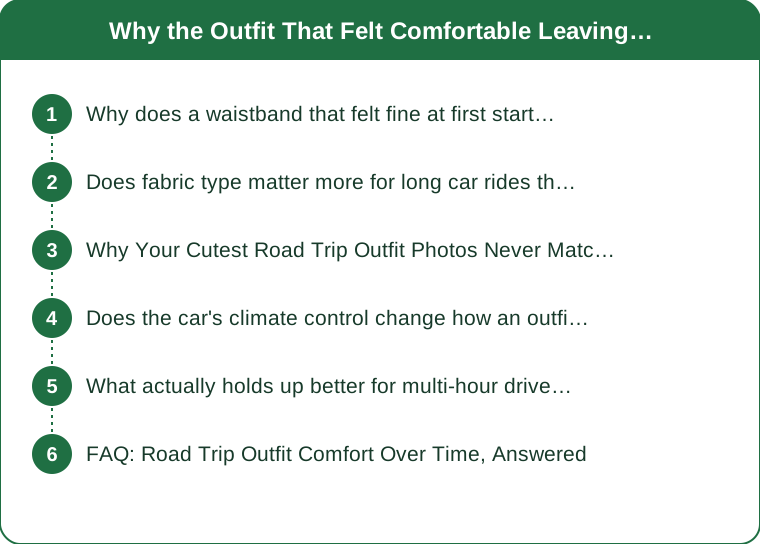
Why does a waistband that felt fine at first start digging in later during a long drive?
Sitting for extended periods concentrates pressure at the waist and hips differently than standing or walking does, and a waistband with minimal give that felt unnoticeable during brief initial wear can create a persistent pressure line after an hour or more of continuous seated compression, which is a cumulative effect rather than something detectable in the first few minutes of putting the outfit on.
Does fabric type matter more for long car rides than for regular daily wear?
Yes — fabric that doesn’t breathe well becomes a bigger issue specifically in a car seat environment, where body heat gets trapped against the seat back for hours without the airflow that walking or standing throughout a normal day provides, meaning a fabric that feels perfectly fine for a few hours of regular activity can feel notably worse during the same duration spent seated and still in a car.
Why Your Cutest Road Trip Outfit Photos Never Match How You Felt
The outfit photo, usually taken standing at a scenic overlook stop, captures a brief moment of movement and fresh air that doesn’t reflect the preceding two hours of seated compression and trapped heat — the visual record and the actual physical experience of the drive diverge because they’re capturing genuinely different moments, not because the outfit choice itself was wrong.

Does the car’s climate control change how an outfit performs compared to the outside temperature it was chosen for?
Often significantly — an outfit layered for the outdoor temperature at departure may not account for how a car’s climate control creates a different, sometimes fluctuating microclimate (especially with sun through windows adding heat, or AC creating cold zones near vents), meaning the same outfit can feel too warm in direct sun through a window and too cold near an AC vent within the same short drive.
What actually holds up better for multi-hour drives specifically?
Fabrics with some stretch and breathability, waistbands with genuine give rather than a fixed structured band, and easily adjustable layers (a light jacket that can come on or off rather than a single fixed-weight top) tend to perform more consistently across the several-hour window a road trip actually involves, compared to outfits chosen primarily for how they look or feel in the first few minutes.
FAQ: Road Trip Outfit Comfort Over Time, Answered
Are leggings automatically the safest choice for long drives?
Generally more forgiving than structured waistbands, yes, but not universally — leggings with a tight, non-stretch waistband or a fabric that doesn’t breathe well can still cause the same digging-in and heat-trapping issues over a multi-hour drive.
Should shoes be different for a road trip than for the destination activity?
Often yes — easily removable, comfortable shoes for the drive itself (even if less ideal for the destination) tend to prevent the swelling and discomfort that can build up in feet during hours of limited movement, with a destination-appropriate pair packed separately.
Is it worth packing a change of clothes specifically for hour three or four of a long drive?
For drives longer than about four hours, packing one easy layer swap (like a looser top or a second pair of bottoms) is a reasonable way to reset comfort partway through rather than tolerating an outfit that’s stopped working for the remaining hours.
TL;DR:
- Waistbands and seams that feel fine briefly can create real pressure discomfort after an hour or more seated
- Fabric breathability matters more in a car seat environment than during normal daily activity
- A car’s climate control creates its own microclimate that can differ from the outdoor temperature the outfit was chosen for
- Stretch fabrics, forgiving waistbands, and adjustable layers hold up better across a multi-hour drive
The outfit isn’t wrong for feeling great at minute one — it’s just being judged on the wrong timeline. Comfort at departure and comfort three hours in are two different tests, and packing for both makes the actual drive match the photo.
See It in Motion
Seen here: Super High Waist Embossed Yoga Leggings with Inner Pocket — shop it on bubblelime.com
Keep Reading
This article is for general informational and styling purposes only. Fit, sizing, and product availability may vary.