Why the Driver and the Passenger Need Completely Different Outfits

Quick Answer: The driver needs unrestricted shoulders, a waistband that does not fold at the hip crease, and shoes with a thin, firm sole. The passenger needs the opposite on almost every count — soft waistband, layers that work while curled sideways, and something that functions as a blanket. Dressing both people the same is why one of you is always uncomfortable.
Every road trip packing guide treats the car as one environment. It is not. It is two seats with completely different physical demands, and the person who swaps into the driver’s seat at hour four usually discovers this the hard way.
The driver is doing sustained low-grade physical work. Arms elevated, spine loaded, right leg engaged, head turning. The passenger is doing the opposite — long stretches of near-total stillness in whatever position happens to be least bad.
Those are different problems, and they want different clothes.

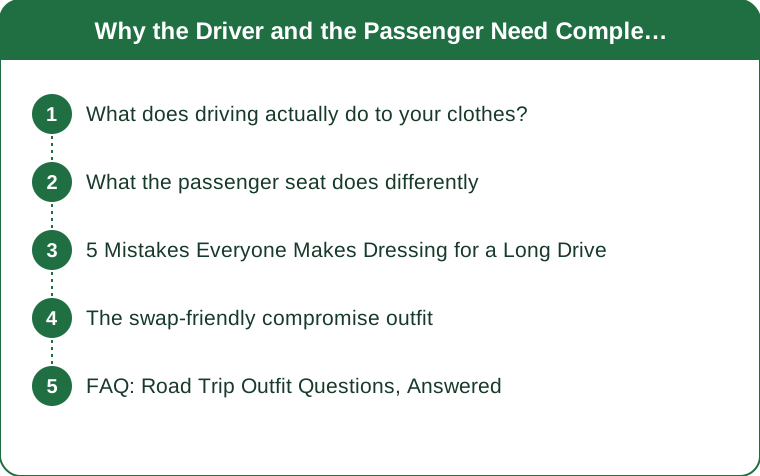
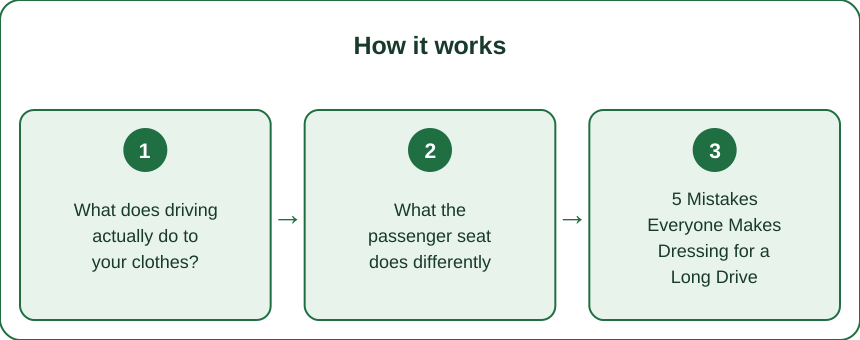
What does driving actually do to your clothes?
It puts constant tension on three specific places, and it does it for hours without variation.
Shoulders and upper back. Your arms are held forward and slightly elevated the entire time. Anything with a tight armhole, a stiff shoulder seam, or a structured jacket back becomes noticeable around the 90-minute mark and genuinely irritating by hour three. This is the single most common driver mistake: a jacket that feels fine standing in a driveway and pulls across the back at every steering correction.
The hip crease. Sitting with your right leg extended toward a pedal creates a permanent fold exactly where most waistbands sit. A rigid waistband — a stiff jean, a belt, anything with hardware at the front — digs in on one side more than the other because the two legs are in different positions. Drivers frequently report one-sided discomfort and blame the seat.
The right foot. A thick, cushioned sole reduces pedal feedback and forces you to press harder, which fatigues the ankle. A firm thin sole with a flexible forefoot is measurably less tiring over several hours.
The pattern: the driver’s clothing needs to allow movement and transmit feedback, which means fitted-but-stretchy rather than loose, and thin rather than padded.
What the passenger seat does differently
The passenger’s enemy is stillness and temperature, not restriction.
You will spend hours in positions no clothing was designed for — turned sideways with one leg tucked, knees against the door, half-reclined. Seams that sit fine when vertical end up pressed between you and the seat, and after two hours a flat-felled seam across the thigh becomes a distinct line you can feel.
Circulation drops without the small constant movements a driver makes. This is why passengers get cold first and get cold in the extremities. It is also why a snug ankle cuff or a tight sock band matters far more in the passenger seat than the driver’s.
Layers behave differently too. The driver cannot easily add or remove anything while moving; the passenger can, and should. The passenger is the one who should carry the oversized layer that works as a blanket, because they can actually deploy it.
Practical passenger set: soft wide waistband, flat or minimal seams through the seat and thigh, loose ankles, and one large soft layer that doubles as a cover. Slip-on shoes, since the passenger takes them off and puts them back on at every stop and the driver mostly does not.

5 Mistakes Everyone Makes Dressing for a Long Drive
1. Both people dressing for the same job. The most common one. Usually both dress like the passenger, and then the driver spends six hours in a soft waistband that rolls and shoes with no pedal feel.
2. Dressing for the destination instead of the car. You arrive in a nice outfit that was miserable for five hours. Pack the destination outfit; wear the car outfit. Changing in a rest-stop bathroom takes four minutes.
3. A belt. There is almost no situation where a belt improves a long drive. If your pants need one, choose different pants for the drive.
4. Layering with a zip-front only. A full-zip is hard to remove while seated and belted. A layer that can come off over the head, or a wrap, works far better in a seat. Drivers should have their temperature layer sorted before they start moving, not planned for later.
5. Ignoring the driver swap. If you are trading off, dress in something that works for both roles rather than optimizing for the seat you start in. The middle-ground answer is a fitted stretch legging or pant with a wide flat waistband, a top with a set-in but stretchy shoulder, and a thin-soled slip-on.
The swap-friendly compromise outfit
When you know you will trade seats, you are looking for the small overlap between the two lists.
Bottom: high-rise with a wide, flat, non-elastic-band waistband in a fabric with genuine four-way stretch. Wide enough not to fold at the hip crease, soft enough to be tolerable curled sideways. Avoid anything with a front rise seam that sits directly over the crease.
Top: a fitted long-sleeve base with a shoulder that moves, plus one oversized outer layer that lives in the passenger footwell and gets handed back and forth. The base layer does the driving job; the outer layer does the passenger job.
Feet: a thin flexible slip-on. It gives the driver pedal feel and the passenger easy removal. Compression-style socks are worth considering on drives over four hours regardless of which seat you are in — swelling is a stillness problem, and both roles are still.
Temperature: the driver runs warmer, always. Driver-side vents and driver clothing should be planned around that. If you fight over the climate control every trip, the actual fix is usually not the thermostat — it is that the passenger is underdressed for a car set to the driver’s comfort.
FAQ: Road Trip Outfit Questions, Answered
Are leggings actually the best choice for driving?
For most people yes, provided the waistband is wide, flat, and high enough to sit above the hip crease rather than on it. The failure mode is a thin rolled elastic waistband, which folds under the seatbelt and creates a pressure line within an hour.
What about the seatbelt across a bulky layer?
A thick coat under a belt reduces how well the belt sits against your body and is uncomfortable at the collarbone. Take the coat off, put it behind you or over you, and wear your layers thin enough for the belt to lie flat.
Does any of this matter on a two-hour drive?
Barely. The differences between driver and passenger comfort start showing up somewhere around the two-and-a-half to three-hour mark, which is also when circulation and seam pressure begin to register. Under two hours, wear whatever you like.
TL;DR:
- The driver needs free shoulders, a wide flat waistband above the hip crease, and thin firm soles for pedal feel.
- The passenger needs soft waistbands, minimal seams through the thigh, loose ankles, and one oversized layer that doubles as a blanket.
- Never wear a belt, and never plan to remove a full-zip layer while belted and moving.
- If you are swapping seats, split the difference: fitted stretch bottom, mobile-shouldered base layer, shared oversized outer layer, thin slip-ons.
Once you stop treating the car as a single environment, the trip gets noticeably easier — and you stop arguing about the air conditioning, because you finally dressed for two different jobs.
See It in Motion
Seen here: High Waist Yoga Leggings with Inner Pocket — shop it on bubblelime.com
Keep Reading
This article is for general informational and styling purposes only. Fit, sizing, and product availability may vary.