Why an Overnight Drive Needs a Completely Different Outfit Than a Daytime One

Quick Answer: Overnight driving drops your core temperature more than daytime driving, involves far fewer stops, and coincides with your circadian low point around 3-5am. That combination means you want more insulation than the temperature suggests, fewer restrictive waistbands, and layers you can adjust one-handed without pulling over.
The outfit that felt perfect for a 10am departure becomes genuinely uncomfortable somewhere around midnight. It isn’t that you chose badly. Nighttime driving asks different things of clothing, and almost nobody plans for the second half of the trip.

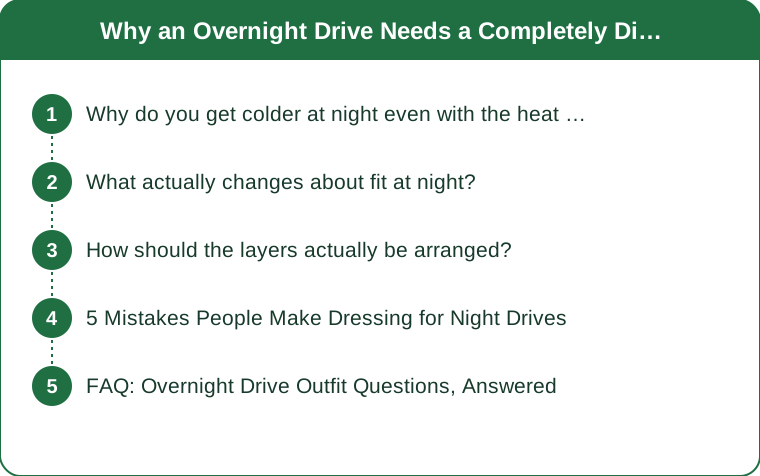
Why do you get colder at night even with the heat on?
Two things stack, and both are working against you.
Your core temperature naturally falls overnight. Body temperature follows a daily rhythm, dropping by roughly 1°C and bottoming out in the small hours. That’s a real physiological drop, and it happens whether or not the cabin is warm.
Sitting still reduces heat production. Muscle activity generates most of your warmth, and driving involves almost none. On a daytime trip you break this up with stops, walking, and food. On an overnight run you might drive four hours without leaving the seat.
The combined effect is that a cabin temperature that feels fine at 9pm feels underheated at 3am, and drivers usually respond by cranking the heat — which dries the air, worsens eye fatigue, and makes drowsiness worse. Wearing a warmer layer instead of raising the cabin temperature is the better trade in almost every case.
What actually changes about fit at night?
Two specifics that matter more than they do in daylight.
Waistbands. Late-night driving usually means eating at odd hours, drinking more fluid to stay alert, and sitting unbroken for long stretches. Any waistband that was borderline at hour two becomes actively unpleasant by hour eight. A soft, wide, non-elastic-heavy waistband — or a drawstring you can loosen without stopping — is worth more than it sounds.
Anything that restricts the shoulders. Night driving involves more mirror-checking, more shoulder-checking at unfamiliar exits, and more tension held in the upper back. A jacket that’s fine for walking can restrict the specific rotation driving requires. Test it seated with your hands at ten and two before you commit to it for 400 miles.
The overlooked one: socks
Feet get cold first and stay cold longest in a car, because the footwell is the coldest part of the cabin and your feet are the least active part of you. A thicker pair of socks does more for overall comfort on a night drive than any other single item, and it’s the thing people most reliably forget.

How should the layers actually be arranged?
The governing constraint is that you can only change one thing at a time, with one hand, without stopping — so the layering has to be built for that.
Base: a soft long-sleeve you’d sleep in. Not a technical base layer; overnight driving isn’t a sweating activity, and technical fabrics next to skin for twelve hours often start to smell. Cotton-blend or modal is more comfortable here than merino’s usual advantage suggests.
Mid: a full-zip, not a pullover. This is the layer you’ll adjust most, and a zip can be opened one-handed at 70mph. A pullover requires stopping.
Outer: something that lives on the passenger seat. Not worn while driving — a bulky jacket in the seat restricts movement and the seatbelt sits wrong over it. Keep it within reach for stops, where you’ll go from a warm cabin to a cold parking lot repeatedly.
Bottom: one layer, chosen well. Doubling up on the bottom half rarely works in a seated position. A single mid-weight, soft-waisted option beats leggings-under-pants for anything over a few hours.
One-handed test
Before leaving, sit in the driver’s seat and try adjusting every layer without using your right hand or looking down. Whatever fails that test won’t get adjusted at 3am — it’ll just be endured.
5 Mistakes People Make Dressing for Night Drives
1. Dressing for the departure temperature. A 9pm start in late August can be 75°F; the same road at 4am can be 20 degrees cooler, and mountain passes more than that. Pack for the low, not the start.
2. Wearing the outer layer while driving. It bunches under the seatbelt, restricts shoulder-checks, and makes the belt sit incorrectly across the chest — which matters for more than comfort.
3. Choosing shoes you can’t drive in and then driving in them anyway. Thick soles reduce pedal feel noticeably. Keep a thin-soled pair for driving and something warmer for stops.
4. Forgetting that rest stops are cold. You’ll leave a 72°F cabin for a 55°F parking lot maybe six times overnight. Without something grabbable, each of those is genuinely unpleasant and you’ll start skipping the stops — which is the actual safety cost.
5. Underestimating how long you’ll be in these clothes. An overnight drive frequently means 14+ hours in one outfit, often followed by arriving somewhere. Anything that’s 90% comfortable is going to be a problem by the end.
FAQ: Overnight Drive Outfit Questions, Answered
Is it worth changing clothes partway through?
Surprisingly, yes — a fresh shirt at a 2am stop is one of the more effective alertness resets available, and it costs five minutes.
What about the passenger?
Opposite problem. Passengers move less and often sleep, so they get colder faster. A blanket for the passenger is worth more than an extra layer.
Do compression socks help on long drives?
For drives over about six hours, many people find they reduce the ankle swelling that comes from prolonged sitting. Worth trying if you’ve noticed that before.
Should I dress differently for a 4am start versus an overnight push?
Somewhat. An early start means you’re warming up as the sun rises, so you’re peeling layers. An overnight push means you’re getting colder throughout, so you’re adding them — pack accordingly.
What’s the single highest-value item?
The full-zip mid layer. It’s the only piece you can adjust meaningfully without stopping, which makes it the one doing most of the temperature regulation.
TL;DR:
- Core temperature drops overnight and sitting still stops you generating heat — dress warmer than the forecast
- Add a layer instead of raising cabin heat; dry hot air worsens eye fatigue and drowsiness
- Full-zip mid layers can be adjusted one-handed; pullovers require stopping
- Keep the outer layer on the seat, not on your body, while driving
- Thicker socks matter more than almost anything else, and get forgotten most
Night driving isn’t daytime driving in the dark. It’s a different set of physical conditions, and dressing for the first hour instead of the eighth is what makes hour eight miserable.
Keep Reading
This article is for general informational and styling purposes only. Fit, sizing, and product availability may vary.