The Packing Order That Decides How Comfortable a Long Drive Is

Quick Answer: Comfort on a long drive is decided by access, not by what you own. A cardigan in the boot is a cardigan you will not wear, so the single highest-value change is packing one small reachable bag with a layer, flat shoes, a hair tie, lip balm, and a snack, and putting everything else out of reach. Dress for the coldest point of the drive rather than the temperature outside your house, because car air conditioning runs colder than you expect over four hours.
Most road trip discomfort is not a clothing problem. It is a logistics problem wearing a clothing costume.
This blog has covered why the first two hours decide what you should have worn and why the outfit that felt comfortable leaving the house does not stay that way. This is the version about where things physically sit in the car, which turns out to matter more than any of it.

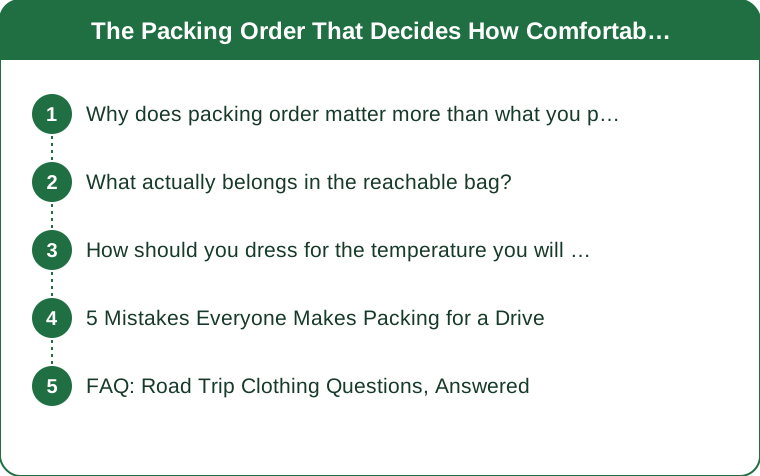
Why does packing order matter more than what you pack?
Because reaching for something requires a decision, and every decision has a cost.
Anything in the boot is functionally not on the trip. Stopping the car, getting out, opening the boot, and digging through a bag is a five-minute interruption. Almost nobody does it for a cardigan. They stay cold for three hours instead and then complain about the cardigan they packed.
Anything in the footwell of the back seat is nearly as unreachable if you are driving. A passenger can get to it; a driver cannot without pulling over.
The reachable zone is small and specific. The passenger seat, the door pocket, the centre console, and the floor directly behind the driver. That is roughly the volume of one small tote, and it should hold everything that changes your comfort.
So the packing decision is a ranking exercise. What will I want without stopping? That list is short and it is not the same as the list of things you packed.
A useful test before you leave. Sit in the driver’s seat and reach for each comfort item without unbuckling. Anything you cannot get to in three seconds is in the wrong place, and you now know it before you are two hours from home rather than after.
What actually belongs in the reachable bag?
Six things, and deliberately not more.
One layer, and it should be bigger than you think you need. An oversized cardigan or a light zip-up works over whatever you are already wearing. A fitted layer that requires removing a seatbelt to put on is the wrong choice for a car.
Flat, easy shoes. Whatever you wore for the departure photo is not what you want at hour three. Something you can slide into at a rest stop without sitting down and untying anything.
A hair tie and a clip. The single smallest item with the highest comfort return over a long drive, especially with air conditioning blowing.
Lip balm and a small hand cream. Car air is extremely dry, and both recirculated air and air conditioning accelerate it. This is the most commonly underestimated item on the list.
A real snack and water within reach. Not in the boot. Hunger on a long drive turns into irritability faster than it turns into hunger, and rest stop options are consistently disappointing.
A small pouch for what comes off. Sunglasses, the layer you just removed, the hair clip. Without a designated place, all of it migrates to the footwell and gets stepped on.
Everything else goes in the boot and stays there. The discipline is in keeping the reachable bag genuinely small, because a large reachable bag becomes a second boot within an hour.

How should you dress for the temperature you will actually experience?
For the coldest point of the drive, then add removable warmth.
Car air conditioning runs colder than ambient over time. A setting that feels pleasant in minute five feels cold in hour two, because your body has stopped generating heat while sitting still. Sitting is a remarkably low-output activity.
Your extremities cool first and fastest. Feet in the footwell get direct airflow in many cars, and hands on a steering wheel sit in the vent path. This is why socks matter more than a jumper for many people.
One side of you gets sun and the other does not. On a long westward afternoon drive, your right or left arm and leg take direct sun for hours while the other side sits in shade and air conditioning. Dressing for the average of those two is dressing wrong for both.
Late summer is the worst season for this specifically. Mornings are cool enough to want a layer, afternoons through a windscreen are genuinely hot, and evening drops again. A single-temperature outfit fails all three.
Choose fabrics that handle sitting. Anything that creases badly will look slept-in by arrival. Knits, jersey, and anything with a small amount of stretch recover; stiff cotton and linen do not.
And avoid anything with a rigid waistband. Seated for hours, a waistband that was fine standing becomes the dominant sensation of the trip. This is the single most common road trip clothing regret and it is entirely preventable.
5 Mistakes Everyone Makes Packing for a Drive
1. Packing the layer in the boot. Covered above and worth repeating, because it is the mistake almost everyone makes and it is the one with the largest comfort cost.
2. Dressing for the destination instead of the drive. If you are driving five hours to somewhere warm, you spend five hours in the car and then arrive. Dress for the five hours and change on arrival. The arrival outfit fits in the reachable bag if it matters.
3. Wearing new shoes. A car is where you discover that shoes rub, because your feet swell over hours of sitting with limited movement. Feet at hour four are measurably larger than feet at departure.
4. Underestimating how dry the air gets. Recirculated air with air conditioning is drier than almost any indoor environment. Lips, eyes, and hands all notice within two hours, and contact lens wearers notice sooner.
5. Overpacking the reachable bag until it is not reachable. The bag works because it is small enough to find things in without looking. Once it holds fifteen items, it is a boot with better placement, and you are back to not bothering.
FAQ: Road Trip Clothing Questions, Answered
What should I wear on a long car ride?
Soft fabrics with a forgiving waistband, a layer you can reach without stopping, and easy flat shoes. Dress for the coldest point of the drive since car air conditioning gets colder over time as you sit still.
Why do my feet swell on long drives?
Sitting for hours with limited movement lets fluid pool in your lower legs and feet. Stop and walk for a few minutes every two hours, and avoid shoes that fit tightly at departure.
How do I stop my outfit creasing in the car?
Choose knits, jersey, or anything with a small amount of stretch, which recover from sitting. Stiff cotton and linen crease permanently within an hour of being sat on and will look it on arrival.
TL;DR:
- Access beats contents. A layer in the boot is a layer you will not wear, so build one small reachable bag.
- The bag holds a big layer, flat shoes, a hair tie, lip balm, hand cream, a snack, and a pouch for what comes off.
- Dress for the coldest point of the drive, not the temperature outside your house, and skip rigid waistbands entirely.
- Late summer is the hardest season for this because morning, mid-afternoon sun, and evening are three different climates.
Do the reach test from the driver’s seat before you pull out. It takes thirty seconds and it fixes the whole trip.
Keep Reading
This article is for general informational and styling purposes only. Fit, sizing, and product availability may vary.